Understanding Our Changing Climate

We see the term climate change come up in media, policy and in our everyday lives. Climate change can be complicated to understand, including how it impacts us and why it is important to inform decision making. To learn more about climate change click on the tabs below. You can also check out our resources page to dig a little deeper!  

When we talk about the weather, we are referring to the outdoor conditions at a particular point in time. Weather includes the actual atmospheric conditions. We might say things like, “The sun is shining!”, “It sure was chilly last week.”, “Look at all this snow!”. Weather also includes short term predictions for questions we might have, like what the temperature is expected to be, or if rain there is in the forecast.  Weather changes daily and seasonally and is an expected part of living in Ontario 

Climate describes observed weather patterns over long periods of time, including temperature, precipitation, and wind. Understanding climate can help to predict the types of activities possible, and considerations needed for specific regions. For example, across Mapleton we experience cold and snowy winters. This information allows us to construction buildings to keep us warm or to plan for planting crops in the Spring and harvest in the Fall. Generally, it is a predictable annual pattern we can plan for.  

Climate change, however, refers to a shift in these predictable patterns, making them less predictable! Globally, Governments, leaders, and scientific communities are tracking these changes to understand climate change and provide information for how to live in changing climates. Climate change is a global problem and experienced in unique ways at the community level. Learning to live with climate change requires collaboration, this means we all have a important role! 

Interactions between Earth systems (land, oceans, atmosphere) can cause some natural variance in climate. However, the main cause is human activities that release Green House Gases (GHGs) into the atmosphere. GHGs hang around in the atmosphere trapping heat from the sun, releasing it toward Earth. This process is called The Greenhouse Effect, and it leads to more overall heat around the surface of the Earth. 

Climate change causes impacts to Earth’s natural systems. This recently published report from Environment and Climate Change Canada states that temperatures in Canada have significantly increased over the past 75 years. Over this time, Canada has seen an average increase of 2.0°C, however, the northern regions are warming about twice as fast. Warming is an important driver for other climate related impacts that have been observed in the natural environment and described in the report. 


Infrastructure and the Built Environment  

Changing weather patterns can also affect buildings and infrastructure, for example through wear and tear over time, and from exposure to increased precipitation, extreme heat or high winds and greater demands on energy systems. Extreme weather events, such as storms and flooding can cause significant damages and disruptions to public services.  

Public infrastructure such as roads and bridges, allow us to safety move between places (works, school, home) and to access the goods and services we need each day (grocery stores, hospitals and emergency services). Damages and repairs cost individuals and all levels of Government, often straining budgets and staffing resources.  

In their Future Focused Climate Mitigation Plan, the County of Wellington describes they types of changes we can expect locally, and how these changes can impact our infrastructure.  Check out this 2026 report from the Canadian Climate Institute, if you would like to learn more climate impacts on infrastructure and what can be done.  


Health  

Climate change impacts human health, safety and wellbeing, because it threatens the essential ingredients we need for good health, including clean air, safe drinking water, nutritious food supply and safe shelter. The World Health Organization describes how climate change creates climate hazards, and when coupled with social conditions can cause negative impacts to our health. It is important to note that the impacts of climate change are not experienced equally by everyone. We all have a role in taking care of ourselves, our communities and our world!  


Wellington-Dufferin-Guelph Public Health (WDGPH) has identified climate hazards and impacts to health we can expect to see locally. A warming climate in Wellington County is expected to bring more frequent and intense heat waves, heavier rainfall, flooding, poorer air quality, and a greater risk of diseases spread by ticks and mosquitoes. These shifts can affect people's health and daily lives, particularly for those who are most vulnerable. To learn more, visit the WGDPH website.  

Climate Hazards 

Impacts to Health 

Thermometer with solid fill 

Extreme temperature  

Increased heat related illness and death 

Dim (Medium Sun) with solid fill 

Ultraviolet radiation  

Potential increase in sunburns and skin damage, skin and eye cancers  

Tornado outline 

Extreme weather events 

Increase in injury and secondary impacts such as mental health 

Mosquito outline 

Food and water borne illnesses  

Risk of exposure to pathogens due to increased flood and storms 

Risk of exposure to pathogens in food due to rising temperatures  

Lungs with solid fill 

Air quality 

Respiratory and cardiovascular diseases and premature death due to poor air quality and more frequent air health advisories  

Leaky Tap outline 

Vector borne and zoonotic diseases  

Increases in West Nile and Lyme disease due to rising temperature and changing precipitation patterns  

Brain in head outline 

Mental Health  

Poor mental health and aggravation of existing mental health conditions  

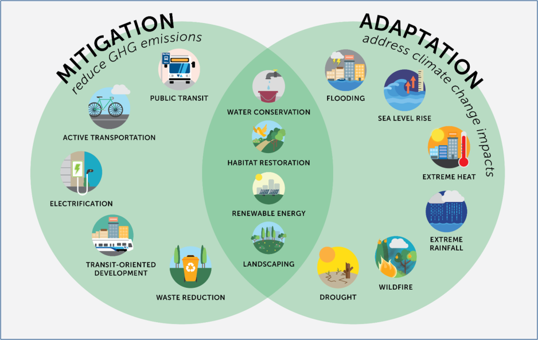
Climate action is happening everyday all around us! Through learning and education, to the choices we make, and the policies and programs that are implemented in communities across Canada. Even small changes count, so the more you know about the more can do! Climate action is generally thought of in two intersecting categories, mitigation and adaptation.

Climate Mitigation refers to any activities that reduces the emission of greenhouse gases.  Here are some examples:

  • Personal/Individual Level: Install LED lights, bike or walk, reduce waste
  • Community Level: Supporting local food systems, municipal policy (electric vehicles, building efficiency)
  • Policy: Wellington County Home Energy Efficiently Transition program

Climate Adaptation includes actions we take to reduce the negative impacts and harm that result from climate change we are already living with. Here are some examples:

  • Personal/individual Level: Limiting outdoor time during heat waves or when the air quality is poor.
  • Community Level:  Advocacy and environmental protection, municipal (building climate resilience infrastructure)
  • Policy: Emergency preparedness resources, planning and services